
Commercial & Residential HRV
A Heat Recovery Ventilator keeps your air fresh while recovering the heat you've already paid for — for healthier, more efficient indoor comfort.
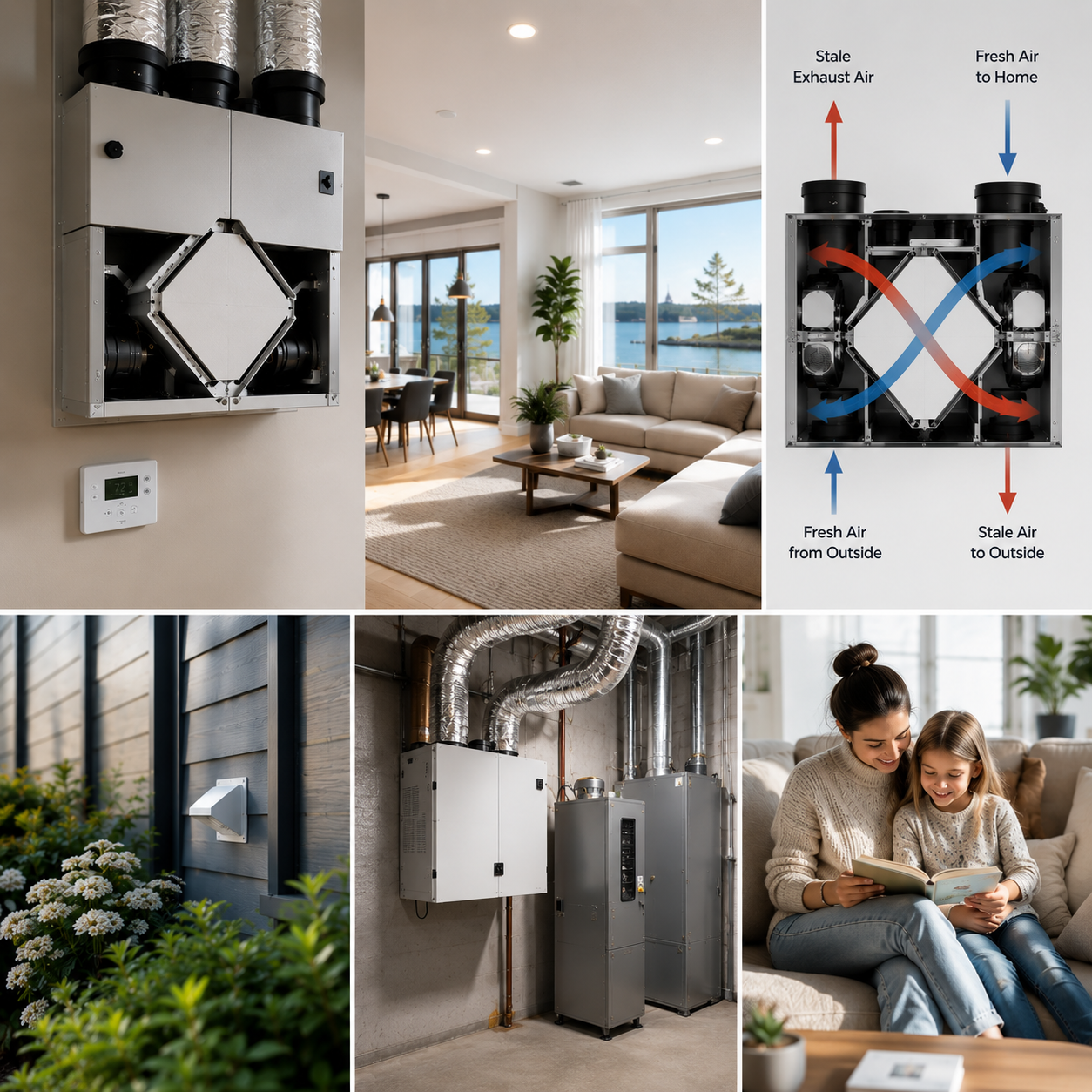
What is a Heat Recovery Ventilator?
An HRV is a controlled ventilation system that reduces high humidity, pollutants and odors by replacing stale air with fresh warm air. Exhaust air is not only stale and damp, but warm. It is this warmth that is used to pre-heat fresh air as it enters your home. All HRVs have two fans and an in-built Air to Air Heat Exchanger, which transfers heat from the exhaust air stream to the cold fresh air supply. By the natural laws of physics, whenever cold air is warmed, humidity is reduced, and condensation control is the result. The two air streams are 100% separated at all times. The fresh air introduced into your home is warm and dry and provides a permanently fresh, healthy, indoor environment.
Energy Efficiency
An HRV can recover up to 5 times more energy than it costs to operate. This level of efficiency is unmatched by any other domestic appliance. Unlike other condensation control devices, HRVs perform best when conditions are at their worst. Sunshine, a warm roof space or heating elements, are unnecessary. HRVs ventilate, 24 hours a day, every day.
What an HRV System Will and Will Not Do
An HRV is a controlled ventilation system that recovers and recycles energy from an Exhaust Air Stream. In winter the HRV recovers heated energy, and in Summer, if your home is air conditioned, the HRV recovers cooled energy.
Winter Operation
Because most IAQ problems occur in winter, the HRV is ideal, because winter ventilation is expensive in terms of energy waste. The HRV is not a heater or a heat pump. It does not generate heat. It captures and recycles heat (or cooled energy) from other sources — log fires, gas heaters, electric heaters, heat pumps, hot water heaters & boilers, coal fires, under floor heating, ceiling heating, night store heaters etc. Whatever the heat source, the HRV will recover the heat from the exhaust air stream and recycle this heat directly back into the home.
The HRV captures and recycles heat that is contained in the polluted exhaust air, by using the heat to warm incoming fresh air. By the laws of physics, whenever air is warmed, its humidity is reduced, and so warm air can absorb moisture. Thus cold incoming outdoor air is dehumidified when it is warmed by the recycled heat. The HRV is a most effective method to control condensation, as well as providing a healthy environment, because the only air entering your home is Fresh Outdoor Air which has been warmed and dehumidified.
Summer Operation - Air Conditioned Homes
In air conditioned homes, indoor air will be cooler than outdoor air, and the HRV recycles cooled energy, in exactly the same way as it recycles heat. The cooled energy is captured by the Heat Exchanger and used to cool the warm outdoor air as it is introduced into the home, for ventilation. This reduces the load on the air conditioning system while providing 100% fresh air ventilation.
Most air conditioners simply recirculate, over and over, the same stale and polluted indoor air. Very few air conditioners have any provision to ventilate the air-conditioned space with fresh outdoor air. Thus most air-conditioned spaces in homes still require ventilation. The HRV saves summer cooled energy just as it saves Winter heat energy.
Indoor Air Quality vs Comfort
The keywords and differences are COMFORT and QUALITY. An HRV ensures QUALITY and it contributes towards COMFORT, but COMFORT is provided by specialized (Heating and Cooling) appliances. In winter, the home needs heating — this is the function of a heating appliance, to provide COMFORT. The home needs a healthy indoor environment — this is the function of the HRV, to provide Acceptable Indoor Air QUALITY. In summer, the home needs a cooling effect, this is the function of an air conditioner, to provide COMFORT. The home still needs a healthy indoor environment — this is the function of the HRV, to provide Acceptable Indoor Air QUALITY.
Summary
An HRV is most effective as a Winter ventilation system to dehumidify and ventilate with 100% fresh outdoor air and to maintain INDOOR AIR QUALITY. In Summer, the HRV will maintain Indoor Air QUALITY, and it will contribute to improving Indoor Air COMFORT. The HRV cannot dehumidify outdoor air when the outdoor air is warmer than indoor air — in these conditions it is a controlled ventilation system that supplies air to, and exhausts air from, the home.